SCERT Odisha holds one common entrance test every year for admission into the two-year Bachelor of Education course, and the paper is set strictly from the published outline. That is why the very first file a serious candidate should open is the Odisha Bed Syllabus in its full paper-wise form. This page keeps the complete outline, the mark split and the chapter list in one place, so you never have to guess what the question setter can ask you.
Everything here is arranged the way you will actually use it: pattern first, chapters next, free demo question PDFs after that, and ten short answers at the end. Read the Odisha Bed Syllabus once from top to bottom today, print the table you need, and return to it every weekend while you revise. A candidate who knows the Odisha Bed Syllabus by heart wastes no time on topics that are simply not asked.
Odisha Bed Syllabus 2026 – Exam Pattern and Highlights
The table below is the quickest summary of the whole Odisha Bed Syllabus. It tells you who conducts the test, how many papers you sit, how long you get and how the marks are shared. Keep this snapshot on your study table, because every later section on this page simply expands one of these rows.
| Particulars | Details |
|---|---|
| Examination | Odisha B.Ed Common Entrance Test |
| Conducting Body | SCERT, Odisha |
| Course | Bachelor of Education (B.Ed) |
| Papers | Paper I (Arts & Science), Paper II (Arts) or Paper II (Science) |
| Question Type | Objective, multiple choice |
| Total Questions | 90 |
| Total Marks | 100 |
| Time Allowed | 120 Minutes |
| Official Website | scertodisha.nic.in |
Now look at the paper structure itself. Paper I is common to both streams, while Paper II changes with the subject group you choose. The Odisha Bed Syllabus gives ten questions each to the four Paper I sections, and the heavier subject blocks sit in Paper II. Both papers are answered inside the same 120-minute slot.
| Paper | Subject | No. Of Question | Mark | Time | Type |
|---|---|---|---|---|---|
| I (Arts & Science) | English | 10 | 10 | 120 Min | MCQ |
| I (Arts & Science) | Education and General Awareness | 10 | 10 | 120 Min | MCQ |
| I (Arts & Science) | Reasoning | 10 | 10 | 120 Min | MCQ |
| I (Arts & Science) | Teaching Aptitude | 10 | 10 | 120 Min | MCQ |
| II (Arts) | General English | 15 | 15 | 120 Min | MCQ |
| II (Arts) | Odia | 10 | 10 | 120 Min | MCQ |
| II (Arts) | History and Political Science | 20 | 20 | 120 Min | MCQ |
| II (Arts) | Geography | 15 | 15 | 120 Min | MCQ |
| II (Science) | Physical Science | 20 | 20 | 120 Min | MCQ |
| II (Science) | Bio-Science | 20 | 20 | 120 Min | MCQ |
| II (Science) | Mathematics | 20 | 20 | 120 Min | MCQ |
| Total | – | 90 | 100 | 120 Min | MCQ |
↔ On a phone, swipe this table sideways to see the Mark, Time and Type columns.
One caution before you use these figures. The notification prints the total as 90 questions for 100 marks, while the subject rows in the same table add up to 100 questions. Both numbers are reproduced here exactly as published, so treat the current advertisement as the deciding word.
Two points are worth underlining. First, Teaching Aptitude and Education and General Awareness are pure scoring blocks, so treat them as the easiest marks in the whole paper. Second, the Arts and the Science versions of Paper II are equal in weight, which means no stream has a built-in advantage.
Odisha Bed Syllabus Question Bank and Demo PDF Download
Reading the Odisha Bed Syllabus becomes far more useful once you see how those topics are actually asked. The question bank below is arranged subject by subject for CT Entrance, B.Ed Arts and B.Ed Science, and each column carries a free demo file you can open right now.
B.Ed and CT Entrance Question Papers with Answer Key
| Items | CT Entrance | B.Ed Arts | B.Ed Science |
|---|---|---|---|
| All Subject Wise (2023, 2022, 2021, 2020, 2019, 2018) Total Question- 7830+ | Buy All PDF | Buy All PDF | Buy All PDF |
| Free Sample File | Demo PDF | Demo PDF | Demo PDF |
↔ On a phone, swipe this table sideways to see the CT Entrance, B.Ed Arts and B.Ed Science columns.
The demo files are small on purpose. The CT Entrance sample covers the Odia language section, the Arts sample is taken from Geography and the Science sample is a Mathematics set, so between them you can judge the standard of every part of the Odisha Bed Syllabus.
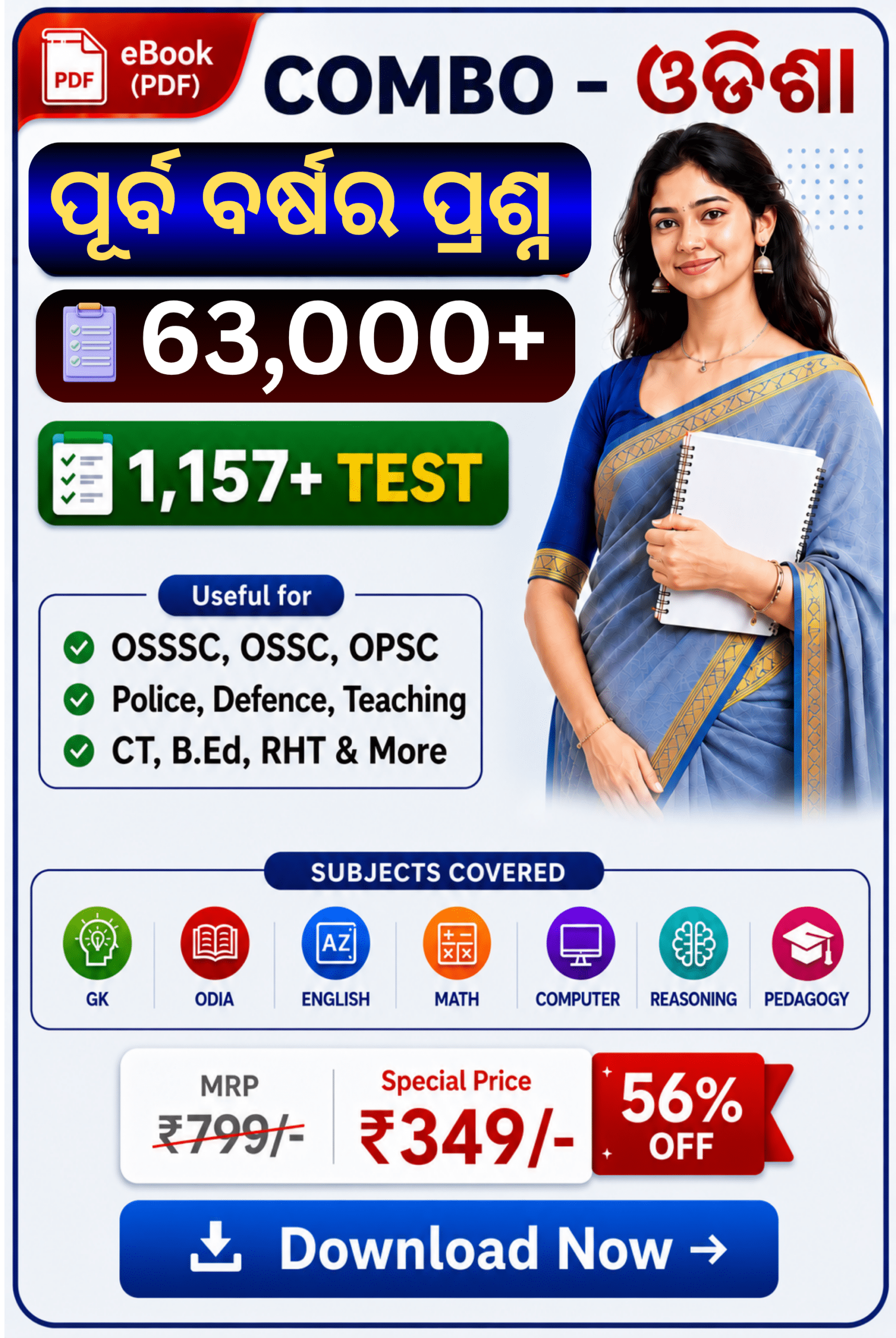
Bonus – All Odisha Combo Question Banks
| Question Bank | Download Link |
|---|---|
| All Odisha 63,000 Previous Year Question & Answer Combo | Download |
| All Odisha Science GK 6,119 Previous Year Question with Explanation | Download |
These two combo banks reach far beyond this single entrance test, since they collect papers from many Odisha recruitment and entrance tests. They are optional. The free demo files above are enough to start with, and you can pick up a combo later if you also plan to sit for OTET previous year questions practice or other state exams.
About the Odisha B.Ed Entrance Test Conducted by SCERT
Admission into government and self-financing B.Ed colleges in the state runs through one common entrance test managed by SCERT. Candidates must fill the application form before the last date printed in the notification; a late form is simply rejected, however well you know the Odisha Bed Syllabus. The full notice, along with the outline, is published on the official council website at scertodisha.nic.in.
Once the form is submitted you choose your stream, and that choice fixes which half of the outline you will study for Paper II. Arts candidates take General English, Odia, History and Political Science and Geography. Science candidates take Physical Science, Bio-Science and Mathematics. Paper I stays the same for everyone.
Teacher training in Odisha has several doors, and many candidates apply to more than one at the same time. If you are also looking at the diploma route, check the CT online apply guide, and if your plan is a teaching job straight after the degree, read the OSSTET online apply page as well. Working through the Odisha Bed Syllabus now saves time on all of those.
Odisha Bed Syllabus for Paper I (Arts & Science)
Paper I is the common paper and it carries forty questions. This part of the Odisha Bed Syllabus is the one place where an Arts candidate and a Science candidate compete on exactly the same ground, so the marks here often decide the merit list. The chapter list below is reproduced from the official outline.
| Subjects | Chapters |
|---|---|
| English | Comprehension, Vocabulary & Usage |
| Education and General Awareness | Everyday science, Political system and happenings, General information, Educational committees and commissions, Educational policies and initiatives, Agencies working for education |
| Reasoning | Logical and Analytical Reasoning |
| Teaching Aptitude | Solving problem of educational context, managing classroom and learning, Learner and learning related issues, goals of education, role of various agencies and organization in management of education, issuing related to teaching-learning strategies |
Teaching Aptitude deserves a special mention. The questions are situational rather than factual, so memorising definitions helps less than thinking like a classroom teacher. It is worth practising rather than skipping, because it is among the friendliest sections in the whole paper.
Odisha Bed Syllabus for Paper II (Arts Stream)
Arts candidates answer sixty questions in Paper II, spread over four subjects. The chapters listed here are the exact ones named in the Odisha Bed Syllabus, and the level stays close to the higher secondary standard. History and Political Science carries the largest single block, so plan your revision around it.
| Subjects | Chapters |
|---|---|
| General English | Comprehension – Unseen text Word formation, derivation, antonyms and Synonyms, Spelling and punctuation Grammar (Parts of speech, time and tense, change of voice, Direct and indirect speech and transformation of sentences) |
| Odia | Comprehension – Unseen text Odia Dhwani, Odia Vocabulary – Word formation and syntax, Spelling and Punctuation Grammar (Karaka, Bibhakti, Samasa) |
| History and Political Science | Rise of the British power in India Socio-religious Movements in 19th Century India’s struggle for freedom French Revolution, 1st World War and 2nd World War Salient features of Indian constitution and Fundamental Rights Functions of Legislative Assembly, Parliament, High Court and Supreme Court |
| Geography | Latitude and Longitude Physical division of India Natural Resources Social and economic resources Conservation of forest and wild life |
The Odia section is short but very predictable. Karaka, Bibhakti and Samasa are named in the outline, and unseen comprehension is easy marks for any native reader. Treat these as guaranteed points while you work through the rest of the chapter list.
Odisha Bed Syllabus for Paper II (Science Stream)
Science candidates also answer sixty questions, but they are split evenly across three subjects at twenty questions each. This is the most formula-heavy portion of the whole course, and it rewards steady daily practice more than last-minute reading.
| Subjects | Chapters |
|---|---|
| Physical Science | Atomic structure – Atoms and molecules, classification of elements Chemical reactions and equations Motion – Laws of motion, concept of work, energy pressure and their measurement Electricity and magnetism: Electric Circuit, Potential difference, magnetic Field, lines of force, electro-magnetic induction Heat, Light and Sound |
| Bio-Science | Cell : Structure, Components and Functions Diversities in plants and animals Natural resources Environment – Eco-system, flow of energy, Bio-Geo Chemical cycle in nature, environmental degradation and pollution Basic Physiological function in plants and animals : Nutrition, Respiration, Excretion and Reproduction |
| Mathematics | Number System, Ratio and Proportion Set theory, relations and functions Linear, Simultaneous and quadratic equations, polynomials Theory of Indices, Logarithm and Antilogarithm Trigonometric Ratios and Indices, Problems on height and distance Basic Geometrical Concepts and Geometry of plane figures |
Mathematics carries twenty of the sixty Paper II questions for Science candidates, so it decides a large slice of the score. Indices, logarithm and height-and-distance problems are all named in the outline, and they are quick once the method is fixed in your head. Solve twenty sums a day from this part of the Odisha Bed Syllabus and the paper stops feeling long.
How to Cover the Odisha Bed Syllabus in Time
A plan beats long hours. The routine below has been kept deliberately simple so that a working candidate can follow it too, and it maps directly onto the Odisha Bed Syllabus printed above.
- Print the chapter tables first. Tick each chapter the day you finish it. Seeing the Odisha Bed Syllabus shrink on paper keeps you moving.
- Give Paper I one hour every day. Forty common questions are worth more than any single Paper II subject.
- Rotate your Paper II subjects. Two subjects a day, never one subject for a whole week, or the others go cold.
- Solve a demo PDF at the end of every week. Use the free files above and mark yourself honestly.
- Write down every mistake. A one-page error diary is the cheapest revision tool you will ever build.
- Finish the Odisha Bed Syllabus one month early. Leave the last month for revision and full papers only.
Practice papers from related teacher-training exams also help, because the general sections overlap. Candidates often add the Odisha BPEd 2019 question paper or the Odisha M.Phil 2019 question paper to their practice pile once the Odisha Bed Syllabus is finished.
Benefits of Studying the Odisha Bed Syllabus Early
Starting early is not about studying longer. It is about studying the right things, and the Odisha Bed Syllabus is what tells you which things are right.
- You stop wasting time. The paper is set from the listed chapters, so every other book can wait.
- You budget marks properly. Knowing that Geography carries fifteen questions changes how many days it deserves.
- You revise faster. A chapter list doubles as a revision checklist in the final week.
- You read questions better. Once the Odisha Bed Syllabus is familiar, you recognise the source chapter of a question instantly.
- You stay calm. Most exam-day panic comes from not knowing what is coming, and this page removes that doubt.
Starting on the Odisha Bed Syllabus in the first month leaves room for full length mock papers later, instead of a rushed final week. The same early habit helps with the teacher eligibility test, so it is worth glancing at the OTET eligibility rules while your B.Ed preparation is still fresh.
Important Links for Odisha B.Ed Candidates
Everything else you may need for this admission cycle is collected here, from the application page to previous cut-off marks. Use these along with the Odisha Bed Syllabus above.
| Resource | Link |
|---|---|
| Odisha B.Ed Apply Online | Apply Now |
| Odisha B.Ed Apply (Dates & Eligibility) | Check Here |
| Odisha B.Ed Previous Year Question & Answer | Question Answer |
| Odisha B.Ed Previous Year Question Paper | Download |
| Odisha B.Ed Syllabus (Earlier Version) | Syllabus |
| Odisha B.Ed Syllabus Published by SCERT | Exam Pattern |
| Odisha B.Ed New Syllabus Published | Read More |
| Odisha B.Ed Cut Off Marks | Cut Off |
| Odisha B.Ed Previous Year Cut Off Mark | Check Cut Off |
| All B.Ed Science Exam Subject Notes Free PDF | Free Notes |
| All B.Ed Arts Exam Subject Notes Free PDF | Free Notes |
| B.Ed E-Book, Mock Test and Online Test Series | Open App |
Odisha Bed Syllabus – Frequently Asked Questions
Who publishes the Odisha Bed Syllabus?
SCERT Odisha publishes it along with the admission notification for the B.Ed common entrance test. The version reproduced on this page follows that official outline, and the same Odisha Bed Syllabus applies to government and self-financing colleges alike.
How many papers are there in the Odisha B.Ed entrance exam?
There are two. Paper I is common to Arts and Science candidates, while Paper II changes with your stream. Both are objective and both are answered within a total of 120 minutes, exactly as shown in the pattern table above.
What is the total number of questions and marks?
As per the official notification the paper carries 90 questions for 100 marks. The Odisha Bed Syllabus splits those marks into forty from Paper I and sixty from Paper II, so both papers matter.
Which subjects come in Paper I?
English, Education and General Awareness, Reasoning and Teaching Aptitude, with ten questions each. This block of the Odisha Bed Syllabus is identical for every candidate, whatever stream you have chosen.
What does the Arts stream study in Paper II?
General English, Odia, History and Political Science, and Geography. History and Political Science is the heaviest at twenty questions, and Geography and General English carry fifteen each.
What does the Science stream study in Paper II?
Physical Science, Bio-Science and Mathematics, at twenty questions each. That even split is one of the easier parts of the Odisha Bed Syllabus to plan around, because no single subject can be ignored.
Is the question paper objective or descriptive?
It is fully objective. Every question is a multiple-choice item, which is why speed and accuracy matter as much as knowledge when you sit the paper.
Where can I download free demo question PDFs?
The question bank near the top of this page holds one free demo file for CT Entrance, one for B.Ed Arts and one for B.Ed Science. They open directly, with no sign-up, and they show how the Odisha Bed Syllabus is turned into real questions.
Is the Odia section really necessary for Arts candidates?
Yes. Odia is a named subject in Paper II for the Arts stream and carries ten questions. Grammar topics such as Karaka, Bibhakti and Samasa are listed for it, so it is a scoring section rather than an optional one.
How early should I start preparing?
Give yourself at least four to five months. Finish the Odisha Bed Syllabus one month before the exam and keep that last month for revision, mock papers and the error diary described above.
Conclusion
This page has now covered the whole Odisha Bed Syllabus: the exam pattern with its mark split, the Paper I chapter list, both versions of Paper II, free demo question PDFs and a simple study routine. Nothing here is guesswork, and nothing important has been left out.
Print the tables, tick the chapters as you finish them, and solve one demo paper every week. Treating the Odisha Bed Syllabus as a working checklist rather than a document you read once is what makes exam day feel ordinary. Keep this page saved, and every change SCERT announces to the outline will appear here for you.